Profitability Series
Profitability Series 1: Sales mix
A common mistake brands make while tracking goals on Amazon is doing it in silos, without linking it back to profit, even though profitability is the so-called "go-to-metric".
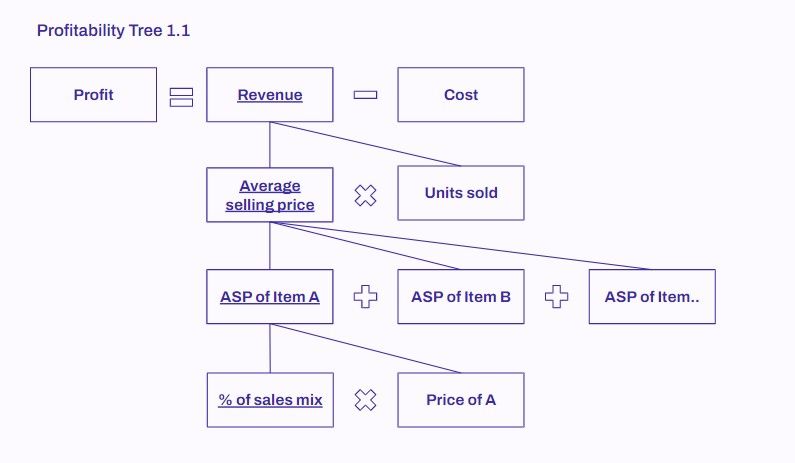
A great way to assess your operations is breaking down revenue and profit based on your sales mix.
Simply put Revenue = ASP x Units sold
1. Understanding this equation & room to test
Typically, ASP and units sold are inversely related; as ASP increases, units sold generally decrease, and vice versa.
However, if you’re a premium brand, you might be leaving money on the table by having a lower ASP. Your target audience might be willing to pay more (economics 101). In this case, increasing price could keep unit velocity constant or reduce it at a decreasing rate, ultimately increasing revenue and boosting profits.
Testing either approach depends on unit economics and brand strategy.
2. Understanding sales mix & impact on all line items
To dive deeper into this simple equation, we can break down ASP to look at it from a sales mix perspective and how that weighted average affects everything from top to bottom line. For example:
- If your hero product generates 70% of total revenue at $25, while others sell for $35, brand ASP drops to $28.
- This impacts amazon seller fees (charged as a % of ASP)
- Further impacting total FBA fees (where the hero makes up a higher share)
- All of which ends up having a bigger impact on overall margin.
Bottom line: If profit is the real goal → evaluate the unit economics of your hero product.
3. Prioritization and Diversification
Sales mix is a starting point in knowing your brand’s diversification level, potential volatility, and areas for prioritization and growth.
Given a hero product’s contribution to total revenue, it should always be a priority. However, it can also be a weak spot if there’s a stock or listing issue. I’ve often seen that top revenue contributors have a lower price point and high unit velocity, leading to a weaker P&L.
→ This is why tapping into the market potential of your remaining portfolio is a great opportunity; not only to spread revenue risk but also stabilize your overall P&L ensuring a consistent flow of profits.
4. So, what’s the takeaway?
Define your brand strategy: Identify your brand’s price point, if it's premium or affordable & start testing early.
Be aware of your sales mix: Look at your catalog from a SWOT perspective
Evaluate unit economics: Analyze how the mix affects the overall P&L
Diversify risk (investing 101): Maximize potential of all products (e.g.,: A can be a revenue driver, B could be a profit driver)
This revenue function and sales mix concept applies universally across channels but serves as a foundational step to understand priorities. In the next post, I’ll introduce more Amazon specific concepts to address the second part of this equation, i.e., units sold, and tie it back to profits!